
By now, you probably have a favorite AI search engine (also known as an AI answer engine), plus a backup for when it has a hallucination; and if you’re like 90% of your coworkers, you regularly use your favorite LLM at work.

So far so good. But if you happen to be one of the millions of people in the U. S. with digital marketing responsibilities, not only are you using AI answer engines on the job; you’re also expected to optimize your employer’s content for them; all while dealing with a steep learning curve and insufficient resources. If that’s your situation, this article is for you. To cut to the chase, start reading from “Strategies to Optimize Content for AI Search”.
How Do AI Answer Engines Work? >
From Blue Links to (Almost) Zero Clicks >
Strategies to Optimize Content for AI Search >
What is AI Search Optimization?
Optimizing for AI search is the process of crafting content so that it is more likely to get mentioned or cited in AI answer engines such as Chat GPT, Perplexity, Gemini, CoPilot, Claude, Grok, and others.
In blog posts and on social media, this new discipline is sometimes called answer engine optimization (AEO) and other times called generative engine optimization (GEO); and it’s often compared and contrasted (in a very serious tone) with traditional SEO. The reality is that, while these search engines surface relevant content in different ways, great content is still great content; and the steps you need to take to ensure that yours is worthy of being mentioned and cited are relatively simple and easy to follow.
AEO vs SEO
When you enter a long, detailed query into an AI-driven search engine, it breaks it down into parts, gets the answers to each of those parts from different sources, and compiles it for you. The more thorough you are in covering your topic the more likely you are to be cited as a source because you don’t need to be the whole answer, you only need to be part of the answer. On Google, your entire page ranks at a given position even though they do pull passages for SERP features.
Takeaway: Optimize for and track citations for AI search engines.
| GOOGLE SEARCH (SEO) | AI SEARCH (AEO) |
|---|---|
| Ranks the entire page based on many factors including content quality and relevance | Cites a page if a portion of it contains the best answer to one part of the question |
| Rewards new information and unique perspectives | Targets concise answers to direct questions |
| Focuses on rankings and traffic | Prioritizes structured content |
| Can render Javascript | Cannot execute Javascript |
| Clicks | Visibility |
| Backlinks | Brand citations across the web |
| Experience-Expertise-Authority-Trustworthiness (E-E-A-T) | |
| Use of schema to understand content | |
| User intent: informational, transactional, navigational, local | |
It’s useful to understand the differences between the way that Google determines which pages to rank highly or reward with SERP features and the way AI engines determine which web pages to mention or cite. Earned media is a key driver of AI visibility, while topical page strength (owned media) drives Google visibility. User intent is important to both.
- Owned. Content that a brand creates and publishes on its website, social media channels, or email newsletters
- Earned. In addition to PR content, this category includes content that is cited by authorities on their websites or linked to from their social channels. It can also include shares, comments, and reviews; as well as invitations to be a guest author.
- Paid. Ads, including social advertising, native advertising, and paid search.
How do each of these channels address user intent?
| Owned Media | Earned Media | Paid Media | |
|---|---|---|---|
| Informational (Know) | Answers to high level questions and the ability to drill down | Has narrowed down choices and wants reassurance and proof | Ignores |
| Transactional (Buy) | Answers to detailed and specific questions | Wants reassurance through social proof | Notices |
| Navigational (Do) | Ability to engage with a chosen brand or brands | Wants reassurance through social proof | May click |
What doesn’t change, for the most part, is the nature of the users’ questions. They are longer and more detailed for AI-driven search engines, but since the goal is the same, the questions are essentially the same as well.
Potential customers ask general questions (head search terms) when they are first exploring a topic, drilling down (to chunky middle and long-tail search terms) as they find information they need and learn from it. Google presents pages that meet their helpful content standards, while AI fans out and gets answers from multiple sources.
As users begin to narrow down their options, the questions get more detailed and specific information is sought. They also want to know what others are saying about this product and what their experience has been. Both Google and the AI answer engines offer information from multiple sources at this point: Google through SERP features such as “Popular Products” and “Videos” and AI engines by presenting multiple options from multiple brands.
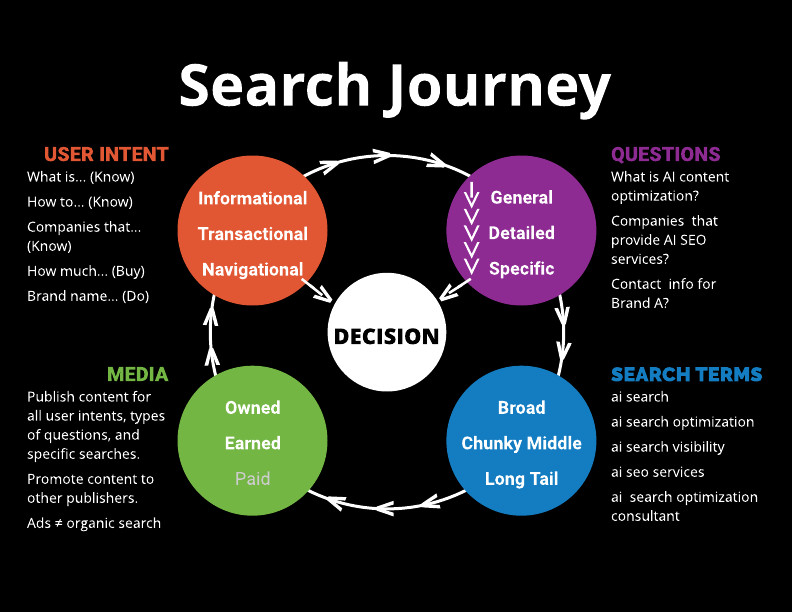
By having content on your website that is the best answer for the questions your customers are asking on their buying journey, you will meet Google helpful content standards, increase your ability to earn SERP features and also be on the radar for fan out queries from AI-driven search engines.
Takeaway: General questions favor publishers and specific questions favor products.
How Do AI Answer Engines Work?
AI-driven search engines are powered by large language models (LLMs) that have been trained with massive data sets and are able to respond to long detailed questions with comprehensive answers — either from their model knowledge or by searching external data sources such as the internet. The engines currently driving traffic to our client websites are ChatGPT, Perplexity, Gemini, Copilot, and Claude. While ChatGPT is the most widely used, each of the engines have their strengths and weaknesses, and often a user base whose characteristics can be loosely defined. This is useful to know when you’re creating content for a specific audience such as attorneys, developers, or healthcare workers.
| ChatGPT | Perplexity | Gemini | Copilot | Claude |
|---|---|---|---|---|
| General consumers, students, and business professionals | Researchers, students, and knowledge workers | General consumers and professionals who use Google products | Microsoft 365 customers, developers who use Github | People in research heavy, compliance focused, or creative environments |
| Trained on multilingual datasets | Gives in-depth answers with linked sources | Integrated with Android devices and Workspace | Integrated with Word, Excel, and Outlook | Able to process long, complex documents |
| Used for content creation, shopping, code generation, & translation | Used for research and verifying information with citations | Used for product research, price comparison and shopping | Used for task automation in Microsoft products and for coding | Used for strategy refinement, analysis, and coding |
| 64% male 50% under 25 yrs Developer use 79% |
60% male 53% aged 18-34 85% of users return |
58% male >50% under 35 34% earn > $100k annually |
12% aged 25-34 14% Asian 33 million active users |
45% corporate traffic 24% major banks 61% healthcare |
LLMs and RAG
LLMs have a lot of data but don’t know how to focus it. Retrieval augmented generation (RAG) provides a focus, a point of view, and additional information for the LLM.
Using the analogy of a child learning (hat tip to Ken Fischer for this analogy), RAG is organized content which provides a generic LLM or AI Tool with a parent, a community, and a teacher to shape how information is processed and how a response is delivered. This transforms the generic LLM into a system which more closely simulates a person because it transforms it from a soulless AI machine to a seemingly almost sentient AI ‘person’.
- As a parent, RAG provides the AI system with a motivation or point of view for how best to understand and present the information. This allows the AI to understand which information to give importance during processing, the style and tone to use when presenting, as well as examples of responses to emulate or avoid.
- As a community, RAG provides an environment in which the query is made so that the AI system is aware of boundaries and expectations for a specific question and the purpose for which it is being posed.
- As a teacher, RAG supplements the AI system’s knowledgebase with alternative or additional or domain-specific information which the LLM should use instead of older or less specific information that is too generic to answer the query. This may include steps on how to process a specific type of query, which sources to use or not to use, assumptions and how to format the response, and whether information used in the response needs to be cited.
All of this is going on behind the scenes when you ask something of an AI engine. Its answer will often, but not always contain a source list from the web. If your content was used to provide the answer, you may get a brand mention, a link to your website, or both.
Mentions and Citations
AI-driven search engines research, cite, and link to content when a question can’t be answered only with model knowledge. They take a single query, break it down into multiple subtopics and “fan out” the sub-queries across various data sources, including websites; synthesizing the results into a single answer that includes information from each of the sub-queries. The information that is surfaced during the fan out process can include brand mentions and citations.
Takeaway: Your website content drives outcomes in AI search in two ways: with brand mentions and with links to your website.
From Blue Links to (Almost) Zero Clicks
Traditional search engine results in Google used to be a list of 10 “blue links” per page, much like Duck Duck Go continues to show now. In those days, visibility was straightforward and easy to understand. The closer your web page was to the top of page one, the more visibility and traffic you would receive. You optimized content for keywords, coveted backlinks, waited to see where you ranked, analyzed the web pages above you and optimized again: chasing those clicks.
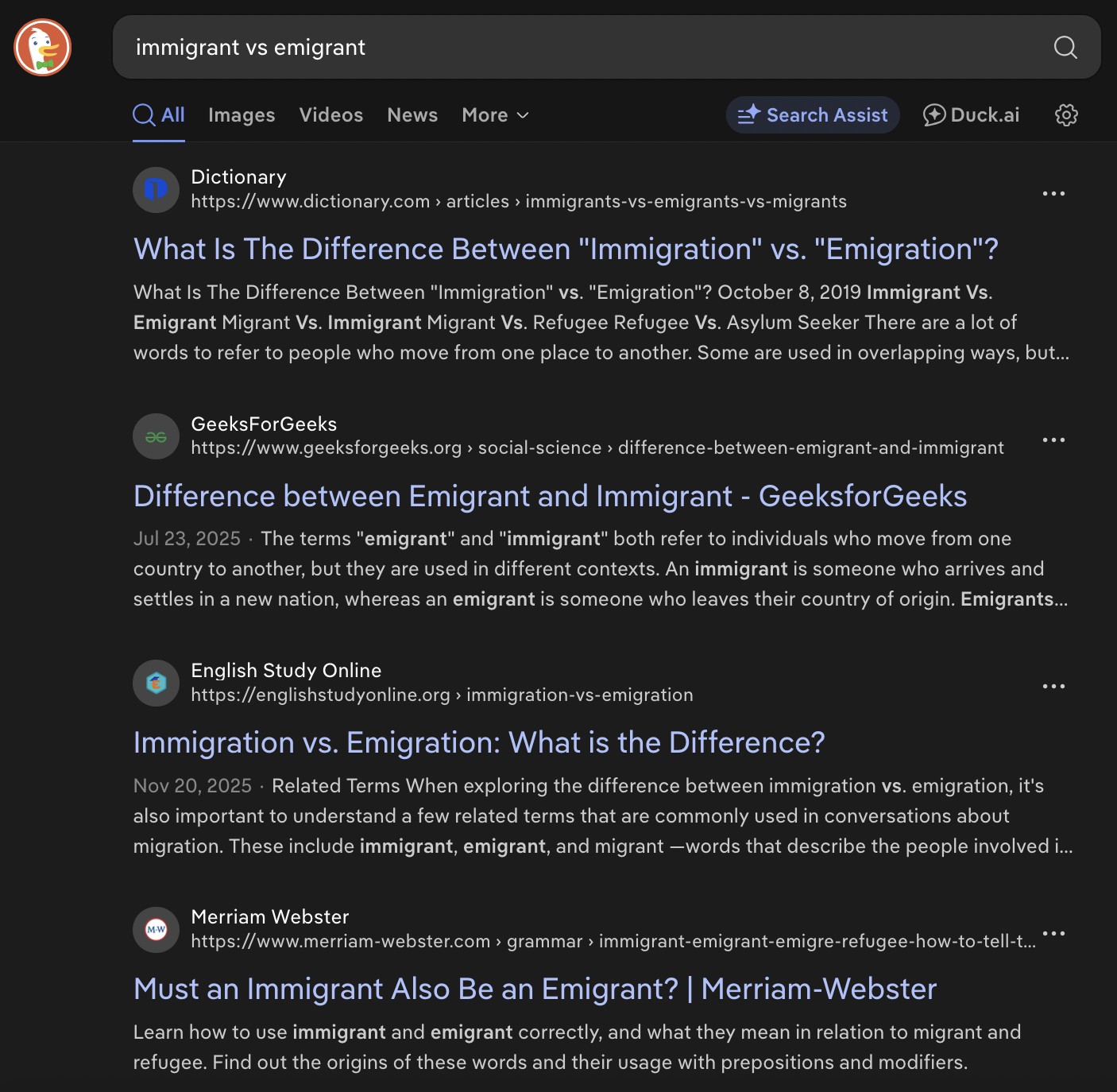
Google’s search engine results page had changed dramatically, even before the advent of generative AI, with a rapidly expanding library of “SERP Features” such as videos and images which displaced the blue links. With the addition of AI Overviews, blue links got pushed even further down the page. On the day I searched, the Google results page for “immigrant vs emigrant” contained (in the following order):
- The AI Overview
- Sponsored results
- Two blue links
- Another blue link
- Short videos
- A 4th blue link
- Videos
- Two more blue links
- Quora
- Another Sponsored result
- People also search for
In addition to AIOs, videos, and forums, “SERP Features” can include images, product listings, people also ask questions, things to know, and more than two dozen other types of featured content. The net result of the ever increasing list of distractions is that positions one, two, and three are now effectively three, four, and five — or worse. Users can get most or all of the information they need while clicking zero links and visiting zero webpages.
Takeaway: The new metrics are visibility instead of keyword rankings and brand impressions instead of clicks.
Strategies to Optimize Content for AI Search
Our AI Content Strategy Study
Six months ago, I ran a series of experiments on client websites to learn where they were being mentioned and cited in the answer engines (not Google AIOs), who else was being cited and mentioned, and if/where there were gaps in topic coverage that they were uniquely positioned to address (E-E-A-T).
This is what I wanted to see with my own eyes.
- What triggers each engine to provide citations?
- Which subtopics are mentioned the most and least frequently in responses?
- Are there gaps in subtopic coverage?
- Which websites are cited most and least frequently?
- In what ways, if any, are the engines unique?
- For each engine, where do our clients have more expertise, better information, or are the only ones talking about something?
This is what I observed.
- The answer engines offered a mix of long, detailed content from known brands and shorter, focused content from unknown or little known brands.
- The citations from top 20 ranked pages were much less than 97% (a stat from an article), they were pulled from all over the web.
- Web pages didn’t need to cover every single subtopic to be cited, but what they did cover they needed to do very well.
- There were enough incorrect summaries (often from outdated information on the web) to offer many opportunities to be cited.
- Users land mid-page much less frequently than I expected, based on the studies I’d been reading. Links to the whole page, as opposed to passage links) offer excellent brand visibility.
- The content cited for our clients had almost all been developed using our robust content development process.
- Where they had featured snippets (PAA Questions, Buyer’s Guides, Videos, Answer Boxes – RIP), they were often cited in AI Overviews as those were rolled out.
- Where they ranked in the top three (when it was still actually three), they were usually cited in AIOs.
- Where they were cited in AIOs, they were also eventually cited in the answer engines.
This is now what we do and recommend.
- Don’t write about topics that are already being summarized from multiple existing authoritative sources.
- Cherry pick subtopics to cover based on gaps in the answer engine coverage, outdated or incorrect information in the response, and your company’s extensive or unique knowledge or experience.
- Write the very best answers to common questions about those subtopics.
- Develop content on topics that no one but you seems to be talking about.
- To trigger a web search; research, find, and add information that the engines can’t get from their model knowledge.
- Interactive tools
- Original research
- Regularly updated charts, product/price comparisons, or searchable databases
- Regional, personal, or direct experience content
- Expert evaluations and problem solving approaches
AI Optimization Tips From Across the Web (And Why They Really Matter)
| Answer Engine Content Advice | The Real Reason to Do This |
|---|---|
| Write modular, purposeful content | IT GIVES THE USER A BETTER EXPERIENCE. |
| Write in conversational, active voice | |
| Use clear, descriptive subheadings | |
| Ensure each passage has a purpose | |
| Write direct answers to commonly asked questions | |
| Use lists, bullets, and tables | |
| Integrate multimedia like FAQs, video, images, graphs |
If you’ve been practicing the craft of SEO for any length of time, you already know to do these things. Sure, answer engines favor content that is written and structured this way, but so do people. We’ve all had times where the title tag promised us a list and then made us scroll through a 1,000 word introduction to find it. Even complex topics need to be organized so that people of various backgrounds can skim for what they need. If structuring content for AI brings us back to putting our users first, it’s well worth it.
How to Make Content Worth the Effort It Takes to Create It
It didn’t take long after ChatGPT was launched for us to be inundated with AI generated content. While it can certainly be useful internally for training, user manuals, and memos; if it was all anyone ever published, the knowledge we have now is all the knowledge we would ever have.
Creative and useful content is like art — good for its own sake. An added benefit is that Google rewards content that brings something new and interesting to the table. The visibility from that often brings your content to the attention of the AI engines as well.
Let’s revisit a well-known tactic that pretty much guarantees you will bring something new to the table: creating content hubs for high priority topics. In our experience topical content that has been written and organized in a hub pattern also earns AI engine citations.

Logically Organized Content Hubs With Topic Clusters
Content hubs are a way of breaking down large topics into manageable pieces so that people can find what they want.
Hub Pages around which relevant content may be built are like the spokes of a wheel, where the landing page is a source of authoritative information and a directory to the subtopic pages. Linking from the landing page to the supporting topic pages allows the spider to understand the breadth and depth of your content.
The exercise of researching and identifying supporting pages ensures that you will be adding value and that your readers don’t “need to search again to get better information from other sources”. In a content hub:
- Most of the content is evergreen
- It’s organized by the way that people search within a broad category, for example AI, and then within the related subtopics of that category such as generative AI, agentic AI, and LLMs
- Hubs can and should offer a variety of content such as articles, research, webinars, podcasts, presentations, data visualizations, infographics, courses, tools, and downloadable templates
- Hubs make it easy to provide both targeted and comprehensive information which covers your user intent bases
- The wheel and spoke approach turns a mass of potentially relevant keywords into a focused, strategic roadmap for content creation
To Execute
- Select a topic that is closely related to your business and expertise
- Conduct keyword research to determine the head terms and related chunky middle terms that can serve as topics and subtopics
- Develop a plan for the internal linking structure of your hub
Topical Depth and Breadth
Topic depth and breadth is made possible by content hubs and conversely, the research required to create a content hub ensures that you will be going deep and wide in your areas of expertise.
Achieving Content Depth
- Cover each topic and sub-topic more comprehensively than the competition
- Focus more deeply on often neglected aspects of the topic
- Expand by adding detail, a closer analysis, or more illustrations
- Explore by asking and answering new questions or making new connections between ideas.
- Examples: Wikipedia pages, WEBMD conditions pages
- Ask
- What questions do others not answer?
- What information do they leave out?
Achieving Content Breadth
- Cover more related topics than the competition
- Cover the full span of knowledge on a subject
- Examples: Stanford Encyclopedia of Philosophy, carparts.com
- Ask
- What related topics do they not cover?
- Where are they less knowledgeable than we are?
To Execute
- Find and fill content gaps in other web content on the same topic
- Speak with SMEs to see what they talk about that others don’t
- Analyze topics that top-performing pages are addressing
- Brainstorm for related – but less commonly used – keywords
Takeaway: The core principles of SEO, especially for high quality content, will give you a head start on visibility in the AI engines.
An AI Content Checklist
- Factual errors that you can correct
- Subtopics that aren’t being covered
- Subtopics that are missing key points
- Spend most of your time writing about subtopics you know better than anyone else in your industry.
- Understand the user intent behind your keywords and subtopic groups and tailor your content to it.
example of how Atigro did this on our website.
- Write in a conversational, active voice.
- Use clear, descriptive subheadings.
- Write direct answers to commonly asked questions.
- Use lists, bullets, and tables.
- Integrate multimedia like FAQs, video, images, graphs.
AI Optimization Links for Technical and Visibility Topics
AI optimization goes beyond content. There are technical and site authority issues that need to be addressed as well, and they are just as important, if not more sometimes, than the content.
For example, AI engines don’t render javascript which means that anything that is rendered client-side is invisible to them. They also don’t use backlinks, which means that they evaluate your authority by the number and quality of mentions and citations you have across the web (earned media): third-party content, social media, news coverage, forum, reviews. Here are a few good articles that cover these topics.
- Is JavaScript hiding your website from AI search results? Here’s how to fix it. Quick to read, easy to understand, and video content if you’re willing to accept cookies.
- Schema Markup and NLP Best Practices. An introduction to schema and entities in answer engines.
- Data Finds Brand Mentions Improve Visibility. The article links to the original research so you can review it for yourself.
- The next thing everyone will be talking about: agentic AI optimization. It even has its own useless acronym, AAIO. Here’s an article about it and here’s one of ours that explains why nobody needs to get their knickers in a knot about agentic AI.
In Conclusion
Unlike traditional SEO which is focused on clicks and keyword rankings, AEO prioritizes earning mentions and brand visibility. Because AI synthesizes answers from multiple sources, content only needs to be the best answer to part of a query in order to be cited.
Successful AEO aligns with best practices for creating high-quality, human-centric content — specifically, modular, conversational, and well-structured writing that uses lists, subheadings, and engagement objects. Marketers can win by strategically filling content gaps by correcting errors, covering neglected subtopics, and offering unique, original research.
Now it’s your turn. I’ve given lots of guidelines in this article. Did I follow my own advice? Can I check every check on my checklist or did I miss some things? Grade me and let me know, and if you find something I truly missed, I’ll update the article and give you credit.
Atigro is the only search consulting company that is also a patent-pending AI-first company. Few understand the inner workings of LLMs better than we do. If you want to stay a step ahead in the rapidly evolving world of AI search, let’s have a conversation.